
European Car Tuning Brisbane | ECU Remap & Performance Upgrades in Capalaba | SemCar Automotive
Independent specialist tuning for BMW, Mercedes-AMG, Audi, Porsche, Volkswagen, Land Rover and Range Rover. ECU remap, Stage 1 and Stage 2 dyno tuning, exhaust upgrades, suspension and big-brake fitments. Honest engineering. Open warranty conversations.
Performance tuning is a different conversation to a logbook service. Owners walk in with specific questions. For instance, what does an N54 actually make at the wheels after a Stage 2 tune. Or whether the EA888 will swallow a downpipe and a remap without giving the long-term reliability away. Likewise, what the supercharged Range Rover 5.0 will do once the pulley and the exhaust come into agreement.
Naturally, this is the level of conversation we have with performance customers every week. Specifically, that depth is what brings most enthusiasts to a specialist in the first place. Our Capalaba European specialist workshop handles the full performance spectrum. From an ECU remap to a Stage 2 dyno tune. Through to exhaust upgrades, cold air intakes, coilover installation, and big brake kit work.
Geographically, we sit five minutes from Capalaba and twenty from Carindale. More importantly, we run the diagnostic tooling, the dyno relationships, and the engineer’s eye for reliability that performance work actually demands.
Why “Just Get a Cheap Remap” Costs You More Than You Think
Performance tuning has a quality range that most owners do not see until it is too late. For example, generic mail-order remap files written for a different market. Or dyno-untested files run on engines that bend over at the first hot day. Then there are lambda-rich tunes that wash the cylinder walls. Plus wastegate-actuator settings that cook the turbo over a 12-month window. The cheap-remap economy is full of these stories.
In short, the gap between a cheap remap and a properly developed dyno tune is the gap between a car that runs hard for 100,000 km and a car that fails the next emissions inspection. The two products are not comparable. However, they are often priced as if they are.
The Manufacturer Warranty Conversation You Deserve
Here is the part most performance customers never hear. A properly executed independent tune at a workshop running factory-grade diagnostic platforms does not void your manufacturer warranty in the way the dealer often implies. Specifically, under Australian Consumer Law, the manufacturer must prove the modification caused the specific failure they are refusing to cover. In practice, the conversation is more nuanced than “tune voids warranty.” Therefore, we have it openly with every performance customer at booking.
Roadworthiness Under Queensland Light Vehicle Modifications
Equally, the roadworthiness conversation matters. Modifications must be code-compliant under the Queensland Light Vehicle Modifications scheme to remain roadworthy. For instance, ECU tuning, exhaust changes after the catalyst, intake changes, and suspension changes all sit in defined modification codes. Accordingly, we tune, fit and document the work to keep the car legal on Queensland roads. By contrast, that is the conversation cheap-remap operators tend to skip.
What Most Tuning Shops Cannot Actually Do on Your European Car
Every modern European performance car is a network of control modules talking across CAN-bus, FlexRay and Ethernet. For example, the engine module. Or the transmission. Plus the mechatronics. Then throttle, boost, knock control, and adaptive damping. The headline file is one piece of the conversation. However, the wider tune touches half a dozen modules.
In other words, that wider read-write capability is what separates a workshop that “does tunes” from a workshop that tunes properly. To deliver this, we run factory-grade diagnostic platforms across every brand we tune. Specifically, ISTA for BMW. Likewise, ODIS for the VAG group covering Volkswagen, Audi and Skoda. Meanwhile, XENTRY handles Mercedes. For Land Rover and Jaguar, that means Pathfinder and SDD. Equally, PIWIS covers Porsche. Beyond that, the dyno relationships and the calibration software (HP Tuners, EcuTek, Cobb, MHD, Dimsport) match the brand and the platform.
Why a Dyno-Validated Tune Outperforms an Off-the-Shelf File
A generic remap file is written for a “typical” example of an engine on “typical” fuel quality at “typical” ambient. However, Brisbane heat, Australian 95 RON premium, and the variability between two physically identical engines all sit outside that typical. Furthermore, the wear pattern on a 100,000 km example adds another variable. Naturally, a proper tune accounts for what the specific car in front of us is actually doing.
So that is what dyno time is for. First, we measure the pre-tune baseline. Then the calibration changes go on incrementally. Next come road-load and full-load pulls. Throughout the process, the dyno logs lambda, knock, EGT and boost-pressure deviation. Finally, our team adjusts to the conditions the car will actually live with. Not the conditions the file author assumed.
The Difference Between Stage 1 and Stage 2 Tuning
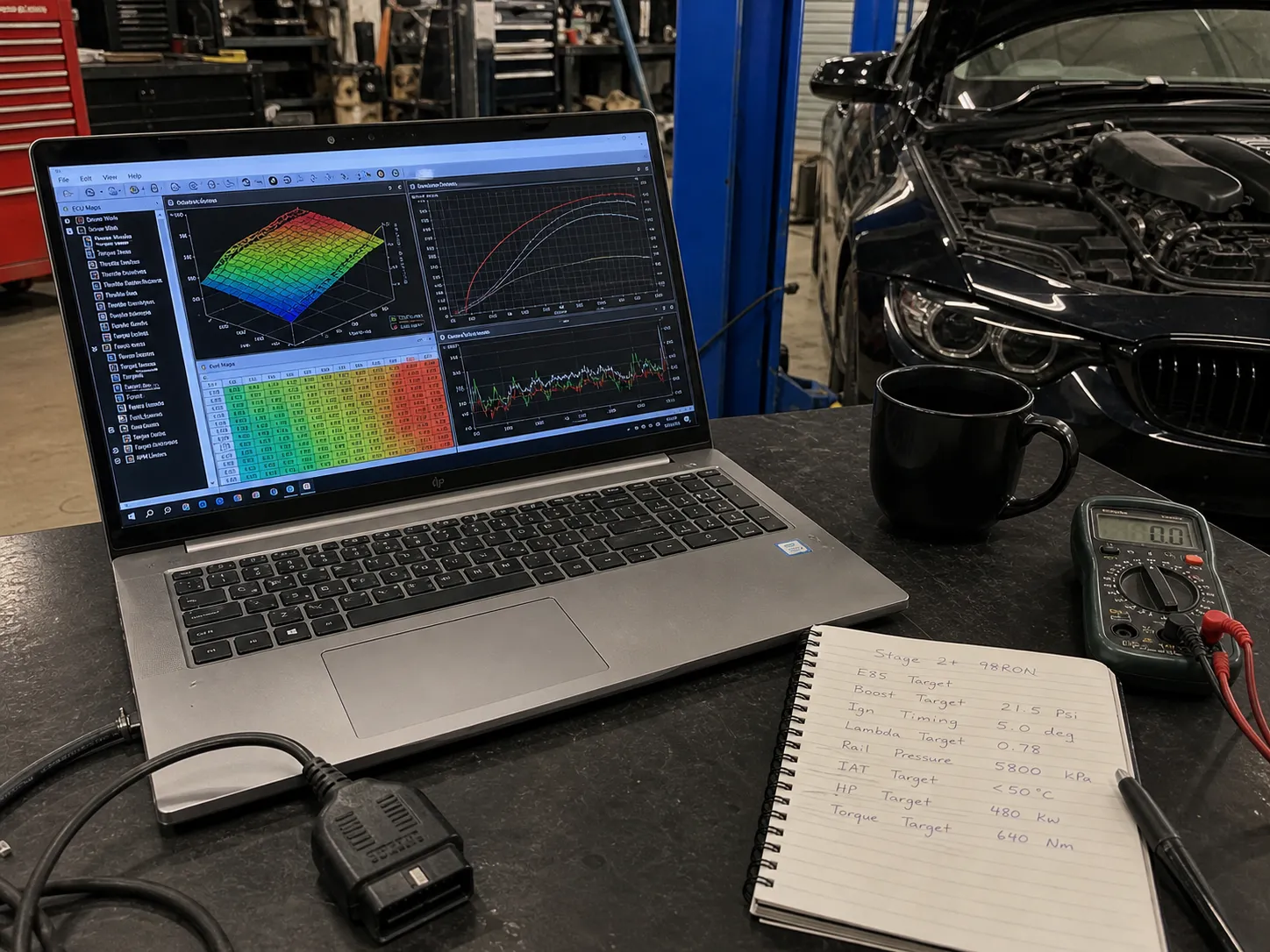
Stage 1 is software only. Specifically, an ECU remap of the existing hardware. The factory turbo stays. So does the factory exhaust. Equally, the factory intake. Typically, gains run 25 to 35 percent at the wheels on most modern turbocharged European platforms. As examples, the N54, N55, N20, B48, B58, EA888 generation 3, AMG M133 and M139, Audi S3 EA888, and the Range Rover supercharged platforms all respond cleanly to Stage 1 work.
The same coding platforms that remap engines also pair and program car keys, which is why key programming and coding lives in this workshop rather than at a locksmith.
By contrast, Stage 2 brings hardware into the conversation. For instance, a downpipe and high-flow catalyst. Plus a cold air intake. Sometimes an intercooler upgrade. Critically, the tune is rewritten around the new hardware, not just rolled forward. As a result, typical Stage 2 gains run 35 to 50 percent at the wheels. Of course, the work demands proper hardware selection, proper fitment, dyno time, and the reliability discipline to keep the engine alive long-term.
Beyond Stage 2, Stage 3 and full custom work brings turbo upgrades, fuelling upgrades, and engine internals into play. Specifically, we do this work for the genuine enthusiast cohort. However, only with frank engineering conversations about reliability, warranty, and roadworthiness before the spanner ever lifts. To start that conversation, book a performance consult and we will walk through the build properly.
What OEM-Equivalent Performance Parts Actually Mean
Depending on the build, we use OEM, OEM-equivalent and quality aftermarket parts. For instance, Bosch, Borg Warner and Garrett for forced induction. Likewise, Mahle and Wossner for engine internals. Meanwhile, APR, IPF and Akrapovic cover hardware. For suspension, Bilstein, Ohlins and KW. As for big brake kits, Brembo, Alcon and Stoptech. Finally, Castrol, Mobil 1 and Motul oils to brand-specific factory specification. Specifically LL-04 for BMW, 502 504 507 for VAG, 229.5 and 229.51 for Mercedes, and A40 for Porsche.
The European Performance Work That Genuinely Needs a Specialist
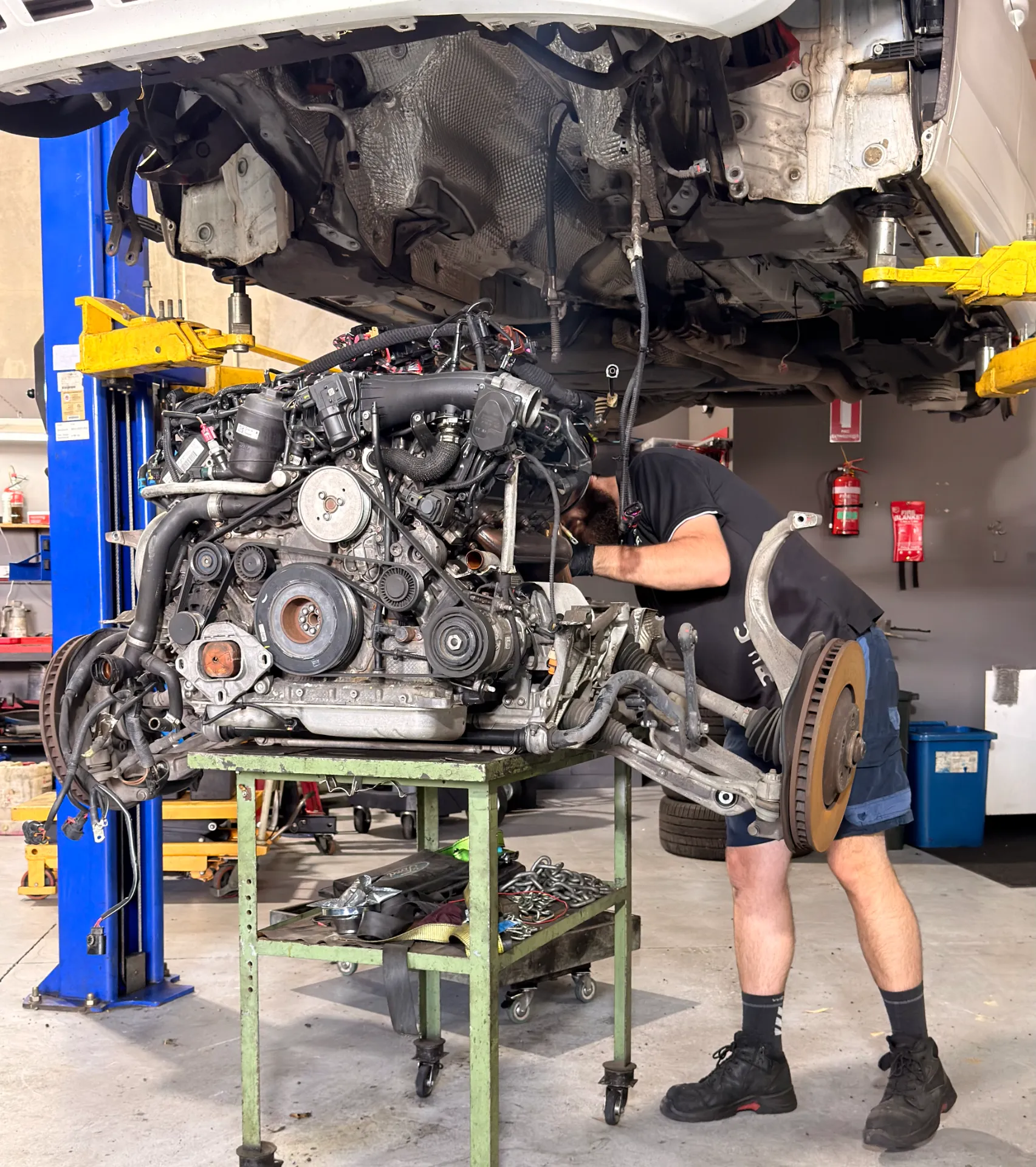
Our performance workload spans the full European mainstream. Plus a healthy slice of the enthusiast end. BMW sits at the centre. Specifically, N54, N55, N20, B58 and B48 work runs through the workshop most weeks. Alongside M Performance variants on the S55 and S58.
Meanwhile, Mercedes-AMG fills the executive end. For example, M133, M139, M177, M178 and the legacy M156 and M157 platforms. Equally, Audi and the wider VAG cohort runs deep on the EA888 generation 3, the EA113 heritage, the EA839 V6 and the V8 platforms.
As for Porsche performance work, that covers the 9A1 and 9A2 flat-six platforms across 911. Plus the Macan and Cayenne forced-induction V6, and the Panamera V8 lineup. Meanwhile, Volkswagen Golf GTI and Golf R remain a workshop staple. In fact, EA888 Stage 1 and Stage 2 work runs through almost weekly.
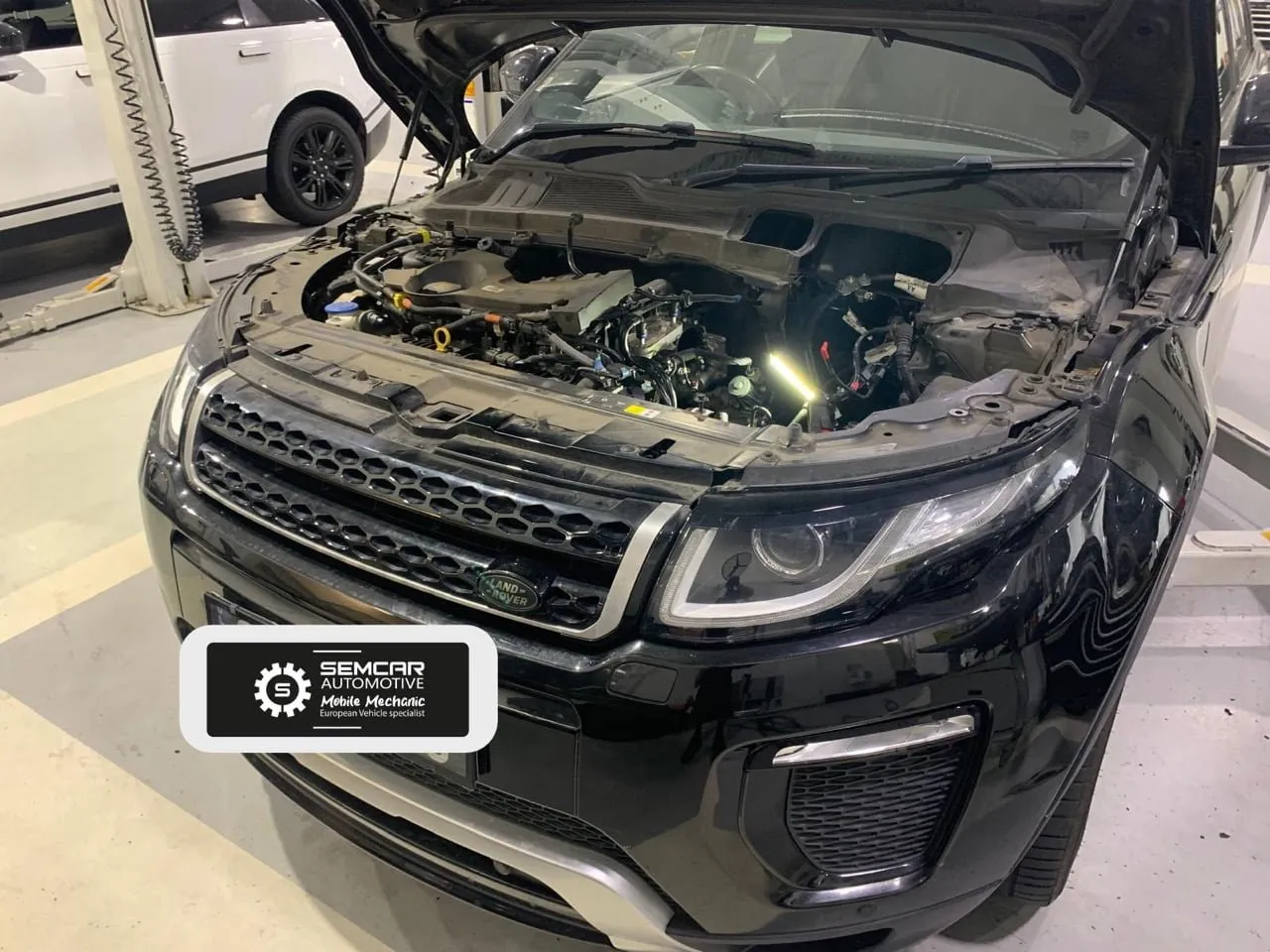
Finally, Land Rover and Range Rover performance covers the supercharged 5.0 V8 across L405 and L494 platforms. Plus the Ingenium 2.0 and 3.0 turbo diesels. As well as the modern Defender L663.
For Land Rover and Jaguar owners specifically, there is a second path. Our factory power upgrades recalibrate your engine to a higher output JLR itself ships. In other words, an alternative to aftermarket tuning that stays entirely inside manufacturer specifications.
The Specialist Performance Work Brisbane Owners Book Most Often
The performance work coming through our Capalaba workshop falls into three logical groups. First, software calibration. Second, brand-specific tuning. Third, hardware fitment.
Software Calibration and Stage Tuning
- ECU remap and Stage 1 tuning. Software-only ECU remap across BMW, Mercedes-AMG, Audi, Volkswagen, Porsche, Land Rover and Range Rover. Dyno-validated calibration. Read-write through ISTA, ODIS, XENTRY, Pathfinder and PIWIS depending on the platform.
- Stage 2 dyno tuning. Hardware-and-software Stage 2 work. Specifically, downpipe, high-flow catalyst, cold air intake, and intercooler upgrade. Plus the bespoke calibration that keeps the engine reliable on Brisbane fuel and ambient.
- Diesel ECU remap and tuning. Road-legal diesel ECU remap that adds usable mid-range. Without compromising the long-term reliability of the DPF and SCR system. Especially strong across the Range Rover Ingenium platforms, the Volkswagen 2.0 TDI cohort, and the BMW diesel lineup.
Brand-Specific Performance Tuning
- BMW N54, N55, B58 and S55 tuning. JB4, MHD and Bootmod3 platform work. Full bolt-on builds. Walnut blast service alongside the tune. Plus the wastegate, charge pipe and oil cooler work that defines reliable N54 and N55 ownership.
- Mercedes-AMG performance tuning. M133, M139, M177 and the legacy M156 and M157 calibration. Plus downpipe fitment. As well as the sport exhaust and intake work the AMG enthusiast cohort tends to plan together.
- Audi and VAG performance. EA888 Stage 1 and Stage 2 tuning. Plus APR-platform calibration. Beyond that, EA839 V6 work on the SQ5 and S5. Likewise, the wider Golf R, S3 and RS3 build profile.
- Porsche performance work. Stage tuning on 911 forced-induction platforms. Macan and Cayenne V6 calibration. Exhaust upgrades. Plus the bespoke build conversation 911 enthusiasts deserve.
- Range Rover and Land Rover performance. Supercharged 5.0 pulley and exhaust packages on L405 and L494. Ingenium diesel tuning across Discovery, Velar and Defender. Plus the Range Rover SVR-spec performance build.
Hardware Fitment and Chassis Upgrades
- Performance exhaust upgrade Brisbane. Cat-back and full turbo-back exhaust fitment in stainless steel. With heat-shielding, bracketing, and the calibration work to make the new system play with the existing tune.
- Cold air intake and intercooler upgrades. Properly heat-shielded cold air intake fitment. Plus dyno calibration. As well as front-mount and side-mount intercooler upgrades on platforms where the factory unit becomes the bottleneck.
- Coilover installation and big brake kit fitment. KW, Bilstein, Ohlins, ST and Eibach coilover fitment. With corner-weight setup and alignment. Plus Brembo, Alcon and Stoptech big brake kit installation. Including proper bedding-in and pad-disc matching.
Stage Tuning at a Glance
Below are typical gain ranges on healthy modern European platforms tuned to factory-fuel-grade specification. Importantly, numbers are wheel power on our standard dyno protocol. Not flywheel marketing claims.
| Platform | Stage 1 Gain | Stage 2 Gain | Notes |
|---|---|---|---|
| BMW N54 (335i, 535i, Z4 35is) | +60-90 hp | +110-180 hp | Stage 2 needs methanol or E85 for headline numbers |
| BMW B58 (M140i, 340i, 440i) | +70-100 hp | +120-160 hp | Excellent OEM internals, very reliable to Stage 2 |
| BMW S55 (M3, M4 F80 F82) | +60-80 hp | +90-130 hp | Charge pipe upgrade strongly recommended at Stage 2 |
| Audi VW EA888 Gen 3 (Golf GTI, S3, A3) | +50-70 hp | +90-130 hp | APR and IPF platforms both well-supported |
| Audi EA839 V6 (S4, S5, SQ5) | +60-80 hp | +90-120 hp | Pulley upgrade unlocks the full Stage 2 potential |
| Mercedes-AMG M139 (A45, CLA45) | +40-60 hp | +70-100 hp | Limited Stage 2 hardware availability currently |
| Range Rover Supercharged 5.0 V8 | +50-75 hp | +90-130 hp | Pulley plus exhaust plus tune the standard package |
| Porsche 9A2 turbo flat-six (991.2, 992) | +60-90 hp | +110-150 hp | Bespoke calibration pathway on the 992 platforms |
Local Performance Tuning Specialists Serving Alexandra Hills, Chandler and Carindale
European performance ownership in Brisbane sits squarely across the eastern suburbs and the Redlands. Specifically, owners who use their cars properly. For example, weekend mountain runs to the Scenic Rim. Or track days at Lakeside and Morgan Park. Likewise, daily drives that reward the kind of mid-range a proper tune unlocks. However, most of the credible performance shops sit on the western corridor or the Gold Coast. Therefore, our service catchment overlaps cleanly with where the eastern Brisbane and Redland City performance owners actually live.
Performance Tuning in Alexandra Hills
Alexandra Hills sits five minutes from our Capalaba workshop. Locally, the family-SUV-and-performance-saloon profile produces strong Golf GTI, Golf R, S3, M140i, M340i and AMG A45 numbers in our weekly tuning bookings. Typically, Stage 1 ECU remap is the most common starting point. However, many owners progress to a full Stage 2 build at the 60,000 to 90,000 km mark. Specifically, when the warranty conversation has settled and the appetite for the real package builds. For broader local detail, read more about the European specialist mechanic in Alexandra Hills.
Performance Tuning in Chandler
By contrast, Chandler’s larger acreage properties favour the bigger performance variants. For instance, Range Rover supercharged 5.0, Cayenne Turbo, X5 M, and the genuine 911 enthusiast cohort all sit in the local mix. Naturally, performance demand from Chandler tends toward the longer-build conversation. Specifically, pulley packages on the supercharged Range Rovers. Plus Stage 2 work on the X5 M. As well as full custom calibration on the 911 turbo platforms. For broader detail, our dedicated page on European specialist mechanic in Chandler covers the local offering.
Performance Tuning in Carindale
Meanwhile, Carindale customers reach the workshop in approximately 20 minutes via Old Cleveland Road. In context, that is a fraction of the time most credible tuning shops on the western corridor demand. Locally, the performance-saloon and SUV mix produces consistent BMW, AMG, Audi S and RS, and Porsche bookings. As a result, many owners step away from the long drive across Brisbane in favour of a credible specialist closer to home. For broader detail, read about the European specialist mechanic in Carindale on the dedicated landing page.
Wider Service Area
Beyond our three primary suburbs, we regularly tune European performance cars from across the wider eastern Brisbane and Redlands region. For example, Cleveland, Wellington Point, Wynnum, Manly, Cannon Hill and Victoria Point all sit within our regular catchment. In addition, customers travel from the Northside and the Gold Coast specifically for the tune. To view the full list, see the wider Brisbane and Redlands service catchment area.
What Brisbane Performance Owners Say About Working With Us
The engineering judgement that separates a tune from a properly built car
Sebastian and Travis went out of their way to assist me with a really complicated issue on my car. Thank you kindly for your awesome service and I will be back with my other cars.
★ ★ ★ ★ ★
Iqbal Kathrada
Google Local Guide · Verified Google review
The Questions You Must Ask Before Booking Your Performance Tune
What Should You Actually Pay for European Car Tuning in Brisbane?
Pricing depends on the platform and the depth of the work. Typically, a Stage 1 ECU remap on a BMW B58, Audi EA888 generation 3, AMG M139 or Range Rover supercharged platform lands at $1,200 to $1,800. That includes full pre-tune diagnostic, dyno time, and a written gain report. By contrast, a full Stage 2 dyno tune with downpipe, intake and any required intercooler work typically lands at $3,500 to $6,500. Naturally, that depends on hardware selection. Beyond Stage 2, custom builds run higher. However, we quote the package upfront before any work begins. In practice, honest specific quoting is the standard on every performance booking.
Will an ECU Tune Void My Manufacturer Warranty?
This is the most important question performance customers ask. However, the answer is more nuanced than the dealer typically suggests. Specifically, under Australian Consumer Law, the manufacturer must prove the modification caused the specific failure they are refusing to cover. In other words, they cannot void the warranty across the board because the vehicle has been tuned. Of course, modifications can affect specific component coverage. As a result, the conversation depends on the platform, the modification, and the failure pattern. Importantly, we have this conversation openly with every performance customer at booking. Furthermore, we keep documented records of the pre-tune diagnostic and dyno baseline. Therefore, the car has a defensible service history if a warranty conversation arises later.
How Much Power Will a Stage 1 Tune Actually Add?
Honest numbers are the only numbers worth quoting. Specifically, on the modern turbocharged European platforms (BMW B58, B48, N55, N54, Audi EA888 generation 3, AMG M139, Range Rover supercharged), Stage 1 typically adds 25 to 35 percent at the wheels with the factory hardware. As a strong example, the B58 in the M140i, M240i, 340i and 440i is one of the strongest responders. Likewise, the EA888 generation 3 in the Golf GTI, Golf R, S3 and Audi A3 sits close behind. By contrast, the N54 from the heritage 335i and 535i responds cleanly to Stage 1 but really opens up at Stage 2. Specifically, once the methanol or E85 conversation enters. For more detail, the headline gain ranges sit in the table further up the page.
Are Performance Modifications Legal in Queensland?
Yes, with the right paperwork. Specifically, the Queensland Light Vehicle Modifications scheme defines specific modification codes (the LS, LA and LB codes). For example, those codes cover ECU tuning, exhaust changes, intake changes, brake changes and suspension changes. As a result, modifications under those codes remain road-legal when the work is performed and documented to the standard the LVS requires. Accordingly, we tune, fit and document the work to keep the car compliant on Queensland roads. Importantly, that includes the modification record sheet supporting any future roadworthy or insurance conversation.
What Is the Difference Between a Cheap Remap and a Proper Dyno Tune?
Functionally, the cheap remap is a generic file written for a different market. Often without dyno validation. Often without lambda or knock logging. Equally, often without consideration for Brisbane heat and Australian fuel quality. As a result, the cheap-remap economy produces the long-term reliability stories you read in the BMW and VAG forums. By contrast, a proper dyno tune starts with a pre-tune diagnostic and a baseline dyno pull. Then the calibration is layered incrementally with full-load logging on every step. Once complete, the car leaves the workshop with a written gain report. Plus a saved calibration backup. As well as a calibration validated on the specific car under Brisbane conditions. In short, the pricing gap reflects the time, the dyno cost, and the engineering judgement that the proper tune carries. Equally, the reliability gap reflects the same.
Can the Tune Be Reversed if I Sell the Car?
Yes. Specifically, we save the factory calibration before any tune is uploaded. Then we keep the backup on file for the life of the relationship. For example, if you sell the car or the next dealer service requires a stock file, we restore the factory calibration in a single workshop visit. Likewise, the same applies if you progress from Stage 1 to Stage 2 and decide later to revert. In other words, the factory file is your property. Therefore, we treat it that way. In practice, this is one of the differences between a workshop with proper calibration discipline and a generic-file operator who often cannot reverse the work cleanly.
Can You Tune Diesel European Cars in Brisbane?
Yes. In fact, road-legal diesel ECU remap work is one of our consistent workshop offerings. Particularly across the Range Rover Ingenium platforms, the Volkswagen 2.0 TDI cohort, and the BMW diesel lineup. Specifically, the right diesel remap adds usable mid-range. Furthermore, it improves drivability under load. Often, it also reduces regeneration frequency. Importantly, all of this happens without compromising the long-term reliability of the DPF and SCR system. Naturally, we keep the work road-legal and documented to the Queensland Light Vehicle Modifications scheme.
How Long Does a Performance Tune Actually Take?
Typically, Stage 1 ECU remap completes in a half-day. That includes pre-tune diagnostic, calibration upload, road-test verification, and a written gain report. By contrast, Stage 2 dyno tuning typically runs across one to two working days. Naturally, that depends on the hardware fitment scope. Beyond Stage 2, full custom builds run across the timeline the build requires. However, we quote the timeline at the same time as the package. Importantly, a complimentary courtesy car is available across every booking, provided you reserve it when you book, as courtesy cars are allocated in advance, subject to availability, and are not automatically available on the day. To confirm the courtesy car when booking, call (07) 3823 5844 or 0426 935 622.
Where to Find Us in Capalaba
Unit 2, 128 Steel Street, Capalaba QLD 4157
(07) 3823 5844 | 0426 935 622
Book Your European Performance Tune in Capalaba
Whether your M140i is ready for Stage 1, your Golf R is ready for the EA888 Stage 2, or your 911 turbo is approaching a custom build, our Capalaba workshop is ready.
Specifically, we run factory-grade ISTA, ODIS, XENTRY, Pathfinder and PIWIS diagnostic capability. Plus engine-code-deep tuning, honest specific pricing, and a free courtesy car, reserved in advance and subject to availability.
To get started, call (07) 3823 5844 or 0426 935 622. Alternatively, book online in under two minutes.